Denim Première Vision Milan Focuses on Innovation and Technology
MILAN — Amid geopolitical uncertainties and challenges, exhibitors at the latest Denim Première Vision had a clear vision that innovation is the denim industry‘s next trend.
The two-day trade show, which closed May 22, took place at Studio Più at the Tortona district in Milan. This edition marked the first one after trade fair organizer GL Events rebranded its fashion division under the new name The Creative Pole. According to official figures, the fair drew 2,100 visitors, up slightly from 2,037 in the last event and the number of exhibitors declined to 84, compared with 90 last June.
Florence Rousson, chairwoman of the executive board of Première Vision and chief executive officer of The Creative Pole, said “this event, under the patronage of the city of Milan, offers the sector’s industries all the business opportunities, innovations and meetings that accompany one of the world’s most emblematic textile sectors, at the service of a collective creativity in motion.”
According to show director Fabio Adami dalla Val, there was a qualitative balance among the exhibitors representing different sectors of the textile industry, including fabrics, manufacturing, accessories, technologies and fibers. “The show’s success confirms our ambition to make it a premium and demanding event, centered around business development opportunities for the community,” he stated.
The trade show also paid homage to Italian denim maker Luigi Martelli, founder of Martelli Lavorazioni Tessili, who died last January. The retrospective exhibition, in partnership with Isko, traced back five decades of denim evolution in fashion through Martelli’s vision.
Eight conferences were held during the event and included a forecast from Denim Dudes founder Amy Leverton. There was also a discussion about the benefits and impact of ethical sourcing and one about the hybridization of denim, respectively from Ani Wells, founder and director of Simply Suzette, and from design consultant Anne Oudard.
Renewing its commitment to Italian fashion schools, the fair launched the contest “Design the Future.” The students were invited to imagine and develop the visual identity for the 2026 edition. The selected image will be unveiled in November and will serve as the core communication of the event throughout the following year. Also in September, Denim Première Vision will start a series of on-campus presentations.

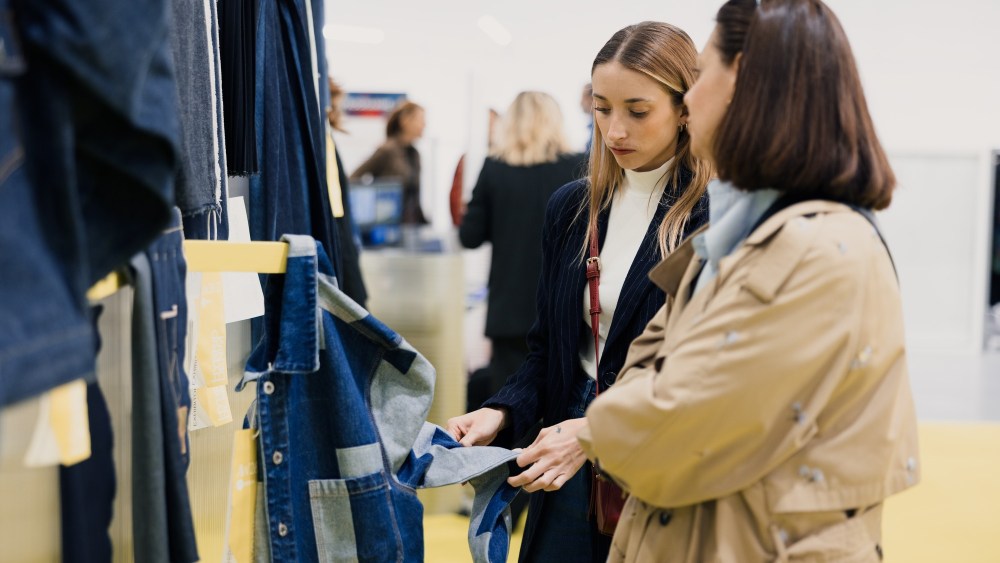
The scene at Denim Première Vision.
Courtesy of Denim Première Vision
On the business side, exhibitors confirmed the challenging period affecting the fashion and textile industry but maintained a positive attitude about the future.
Adami dalla Val said “the current situation is not one of recovery, but rather of adjustment. The introduction of new tariffs is an additional factor that contributes to the market instability.” He mentioned that these factors are affecting the companies that are “undergoing a process of downsizing, where smaller companies disappear and larger ones reduce their activities. It will take further time to have a clear vision for medium-term plans.”
The same feeling was described by Daniele Lovato, general manager of garment-maker and laundry company Elleti Group, who said that they “expect the stability to continue in the short term and potential growth in 2026.”
“The year 2024 has recorded satisfactory sales results, while for 2025 we forecast a period of adjustment or possibly a slight increase in sales,” said Italian mill Berto’s marketing and communication manager Francesca Polato. “Our business covers both foreign and European markets, with a significant presence in France thanks to the collaboration with the luxury brands. We have observed that Germany is starting to show signs of recovery, but we can affirm that Italy has proven to be the most resilient market for us,” she added.
For the majority of exhibitors, the significant changes are leading to growing demand and interest not only in sustainability but also in technical innovations.
Alexander Hanel, head of corporate brand and marketing at German chemical company Rudolf Hub 1922, shared that the past year has been marked by a period of adjustment for them, with notable growth in Asia, especially in Vietnam, and in Europe “which has shown a particular interest in innovative technologies.”
“It is clear that sustainability is a fundamental pillar of the market, with all brands considering the search for eco-sustainable suppliers as a guiding principle. Some have even adopted this requirement as mandatory,” said Christian Reca, collection designer and chief of marketing and merchandising at denim manufacturer Pioneer Denim.

Officina39 Zero PP denim look.
Courtesy of Officina39
A similar trend was noticed by Andrea Venier, managing director of Italian laundry Officina39, who said “2024 has proven to be a positive year, and the first months of 2025 have confirmed our expectations. However, the main challenge of this period is represented by the planning due to significant market fluctuations. We have observed that innovation is a key driver in this context, with a demand which not only focuses on sustainability but also on new technological aspects.”
He added that the most dynamic markets for their business have been Brazil and India, although Bangladesh remained their main market.
The increasing interest toward innovation and sustainability was clear in the collections and new products from exhibitors.
Officina39 presented the ZeroPP|All In technique, which allows the integration of Novascraper Indigo, a technology that delivers a natural, hand-scraped look with precision and efficiency. The technique also incorporates Smart O3, an ozone booster that accelerates the reaction of ozone on indigo, enhancing the bleaching process directly on raw garments. The outcome is a process that is completed in a single machine cycle. The Smart Bright solution is an integrated system that enhances denim brilliance and color depth, preserving fabric integrity in the process.
By combining specialized washing agents for anti-back staining, to prevent yellowing and graying, and for anti-yellowing protection against ozone and nitrogen oxides, Smart Bright delivers results with optimized efficiency and cost. Back staining happens when indigo dye that is released from degraded cellulose during these processes redeposits on the white portions of the garment. The anti-back-staining agents prevent this effect.
Alongside these innovations, Officina39 presented NylonWorn, a waterless finishing process that brings authentic vintage character to nylon fabrics.
Minimizing the environmental impact was the focus of the capsule collection presented by ACM, the Italian specialized accessory manufacturer, and its digital printing division Next Printing, in collaboration with Federico Barengo, Italian designer and cofounder of the brand Garment Workshop.

A look from the NextPrinting-x-Federico Barengo capsule collection.
Courtesy of NextPrinting
The collection includes 100 percent cotton pants and jackets, printed using trompe-l’oeil techniques that recreate vintage denim aesthetics, leather-like effects, and original finishes. The collection features double-sided printing and post-printing treatments, including a waxed effect.
Each piece is produced according to made-to-order standards. Additionally, the amount of water used after garment-making in digital printing is just three liters per garment, compared to the 40 to 60 liters used in traditional finishing processes.
Material wasting is key for Rudolf Hub 1922, which has developed a range of 69 textile chemical auxiliaries with bio-based carbon content ranging from 25 percent to 100 percent. “Reducing the product carbon footprint significantly requires a shift to renewable raw materials,” said Alberto de Conti, who is head of the company.
Examples of bio-based product developments presented at the fair were Feran Bio ICR and Ruco-Pur Bio SLB, two hydrophilizing agents derived from bio-carbon that enhance comfort in polyamide textiles and durability. With these products, the company is able to reduce its reliance on traditional petroleum-based raw materials, minimizing the environmental footprint.
For denim applications the company showcased the Ruco-special LSM, a biocarbon-based laser smoother that enables natural laser effects, and Rucolase DWS, a waterless, bio-abrasive solution for sustainable stonewashing of jeans.
Italian company Xlance, owned by the Carvico textile group, presented its cross-linked polyolefin-based elastic yarn. A sustainable alternative to traditional spandex, the fiber is produced through a clean process that eliminates harmful chemicals, ensuring a lower environmental impact. The new fiber delivers comfort, elasticity along with thermal, chemical and aggressive washing resistance. It is suitable for active sportswear, swimwear and shirting, and has grown its footprint in denim, too. Products by Nike, Adidas and Patagonia feature it.
“We are undertaking a meticulous selection process for the companies we partner with; when a company decides to integrate our fiber into its production, we conduct a collaborative research and development phase. Nevertheless, we have observed a growing interest in our company, with an increasing number of companies showing a strong interest in our solutions,” said Filippo Colnaghi, brand manager of Xlance Srl.

Xlance
Courtesy of Xlance
Sustainability was the focus for the seven new capsules showcased by Isko Luxury by PG, thanks to the fabric technology of Recode Denim, which uses next-gen recycled materials and fiber recovery innovations to create fabrics without compromising on quality. In addition, it maintains the characteristics of the indigo bases produced by Isko. For the next season, it reimagined materials such as wool, chenille and jacquards all brought into the world of denim.
“This collection was born from my desire to create something that will stand the test of time, an item that is not only aesthetically beautiful, but also conveys a sense of unparalleled durability and quality,” said creative director Paolo Gnutti.
For its 2026 collection, Berto featured blends of premium fibers, including merino wool, cashmere, Tencel, and silk. Highlights of the collection included the introduction of Denim Bouclè, a textured fabric which includes organic and recycled content, and the Mirror Denim. The Velvet Denim offers a tactile feel that is customizable thanks to the flock finishes that can be tailored to specific design requirements.


You May Also Like

Salma Hayek, Livvy Dunne & More in Sports Illustrated Swimsuit Issue

NFL legend Brett Favre trashes Bad Bunny pick for Super Bowl halftime show: ‘Pick someone who loves this country’
