Camille Miceli Talks About Pucci Renaissance Thanks to Imagination
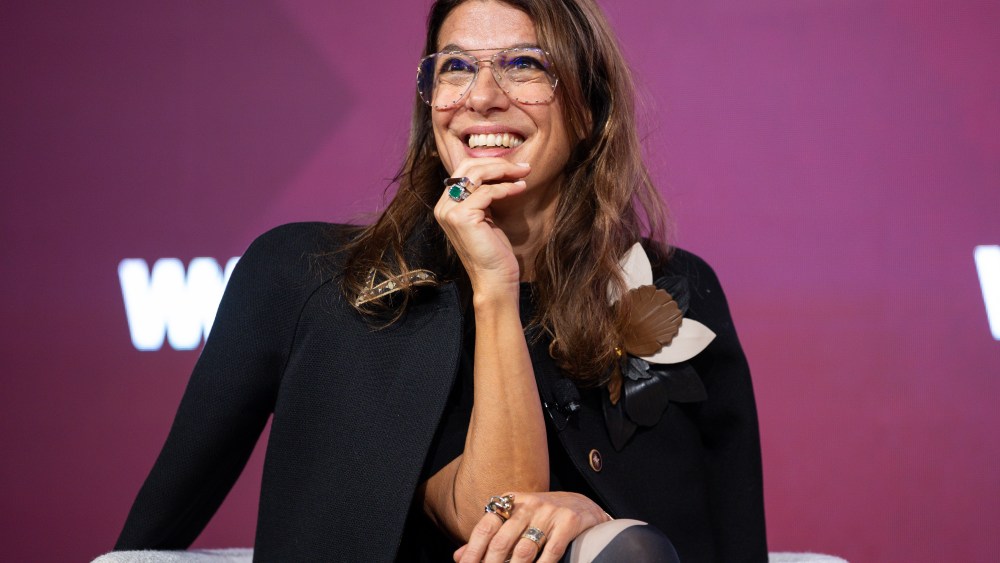
With an abundance of charm, Pucci’s artistic director Camille Miceli personified “Instinct, Imagination & the Pucci Renaissance” during the discussion at the WWD Apparel and Retail CEO Summit with international editor Miles Socha.
When LVMH Moët Hennessy Louis Vuitton called her with “this mission,” she said it was essential to look at the Pucci brand in a different way, which led to more of a see now, buy now business. Although that approach is not typically used by the group, in this post-pandemic world and in light of “all that we are facing today,” Miceli said that having something “so joyful and so positive” makes “you want to embrace that.”
The fact that “women feel beautiful and happy” in the clothes is “what we want at the end of the day,” she said. Explaining how Pucci “broke the luxury mold” with the see now, buy now model and its strategies about shows, experiences and amping up distributing of its collections more in resort locations, Miceli said, “More and more I really want to put Pucci in everyday life. I mean, today I’m wearing a suit and I’m not going to wear that on the beach.”
Others are also following the mindset that Pucci can be everyday wear, including in the city. In line with that thinking, the company opened a store in Houston earlier this year, “which is not a resort place,” as she pointed out.
Acknowledging how the company’s founder Emilio Pucci opened his first store in Capri, where he was “dressing up all of these glamorous women,” she said that initially gave Pucci a reputation for being “a very summer brand.”
“More and more, it is getting into the brains of people that it is another yearlong brand. Thank god,” she said.
While the founder was also known for skiwear, “people forgot,” so Pucci reminded them once she arrived at the house by collaborating with the French ski brand Fusalp on a technical collection. She said, “I like collaborating with people, who have knowledge [about something] that we don’t have. In fact, it worked very well, because I wanted to bring back the history. It’s always important when you work for a brand to do that. I’m here to serve Emilio Pucci. Of course, I have my taste. But I like molding myself into the brand and also bringing my part. But at first, the star is Emilio [Pucci].”
As for how intuition and instinct guide her designs, Miceli said some of that comes down to the fact that she is a woman who is designing for women. In fittings, she thinks about the woman, her shape, and how to amplify her beauty. Prints are naturally paramount to the process, with patterns being taken from the archives and then redrawn. Emilio Pucci was known for drawing by hand. Miceli said, “For Pucci, imperfection is perfection, because, you know, you feel like the human side where like he’s shaking [at times], and the color is not perfect and all that.”
Designing with generations of shoppers in mind, she said her 80-year-old friend wore the brand and was featured in a Pucci look book. “So when I design the collection, I think about all those women and different communities and different kinds of passionate people,” she said.
Asked about her biggest surprise, Miceli spoke of “the richness” of the prints in the archives, and how many of them were drawn by the founder. She said, “I’m in love with the psychedelic ones. I wonder what he was taking, because when you see those things, you’re like tripping just by looking at it.”
Respectful as she is of Emilio Pucci’s work, she said the shapes were quite simple and he used a lot of jersey, which isn’t always flattering to the hips. “So you need to move on and work with fabrics that are more now, and that are more flattering,” Miceli said.
Asked what compelled her to introduce games, pool noodles, pillows, dog beds and other more novel items, she said, “Pucci is about a lifestyle. He used to live very well. And for me, the ‘Bon Vive’ is something like that. If I can try to teach people how to live, where to go, blah, blah, blah, and how to spend your free time, I’m very happy about that. So, I thought immediately, ‘OK, let’s do a backgammon [game], and playing cards.’ Now we did some glasses, and we did a carafe with the charbon to clean the water, because I’m obsessed by water and the lack of water…and one day we’ll do the house maybe.”
Miceli shared some snapshots of some of her prior posts including starting out with Karl Lagerfeld at a very young age. “Very lucky” that Lagerfeld liked her, she said, “You know what he was like. You could be just thrown out the next day. I stayed eight years, which was very long at the time in the ’90s.”
Recalling how after a newspaper article in that no-logo era declared that the “Chanel bag is over,” Miceli said he gave her a sketch of a beautiful Chanel bag with “Chanel forever” and told her to order hundreds of them in jersey in many colors that were later given to runway show guests. “So, the room of the show was full of colors of the Chanel bag. So the Chanel bag was not over,” she said.
Calling Lagerfeld “the king of marketing,” who did not stop working, she said they shared lots of very nice times. The designer also loved telling jokes in French, as she does too. “I was not German, darling. I can’t speak German. I can speak Italian, English, Spanish, but not German,” Miceli said.
Azzedine Alaïa, whom she first met as a friend of her parents at weekly dinners when she was a child, was another close connection. “I told him to take some vitamins to be able to make my wedding dress, and he did do my wedding dress. I did an internship when I was like 16. He was very hard on me. I could not sit; I had to stand up,” adding that he taught her precision down to the centimeter.
She added, “He advised me all the time, and he was pushing me. He was an incredible person. He was not letting anyone do anything…he was a control freak. Probably that’s why I’m a bit of a control freak. Sometimes it’s OK.”
Miceli also chatted about her experience working in communications for the shows at Louis Vuitton under Marc Jacobs and designing jewelry and accessories at Louis Vuitton and Dior. “For the first year, there was no collection to communicate about. So we were just sitting on the floor and thinking, ‘Who is the Louis Vuitton woman?’ Blah, blah, blah. So that was really interesting. Three years later after I had my son, I came back and I said, ‘Listen, Marc, I love you. I love my job. The part that is creative is the show. I don’t want to do the communication anymore.”
She continued, “He said, ‘No problem. You’re gonna be my muse.’ I said, ‘Oh, that’s a bit reductive, but I can amuse you…’ And then one day he said, ‘Would you design a ring for the show?’ And that’s how it started. And that’s what I love about Marc. It’s very instinctive. It’s very immediate.”
Referring to her run at Dior, Miceli said working with Raf Simons was “really good,” partially due to their shared love of art. Designing a tribal earring with pearls was a standout moment but one that happened naturally in the studio and that was inspired by her interest in and travels to Africa.
As for advice for others, who might wish to spread their wings with a creative pursuit, she said, “You always need to stay curious and with your ears and eyes open to catch anything that can you can. At the end of the day, you’re driven by passion, and we do a beautiful job.”
Through Michel Botbol and Naomi Campbell, Miceli found her way to Pucci, which is run by a considerably smaller team than the ones at Chanel and Louis Vuitton. But that suits her just fine. Miceli said, “I love to work with people. We sit around the table and we discuss and we exchange ideas. If you have like, 50 people around, you can’t do that. I mean, have one designer, one assistant designer, Simone, who is my right hand, and one girl for the fabrics. And I like it that way. I like the fact that we only do two collections per year.
“It’s a small collection. It’s very addictive. I don’t want to waste. I hate waste, especially nowadays. We can’t work like this any more.…You see what’s going on in Jamaica [with Hurricane Melissa]. We have to be careful, and we have to preserve that. And the fact of not producing like crazy, I prefer sold out. I love when it’s sold out. ‘Sold-out’ is my favorite word.”
In addition to sprucing up Pucci stores with help from Pierre Passion to give each one its own flair and different merchandising, she has dressed such celebrities as Venus Williams and Beyoncé Knowles-Carter. But seeing any woman dressed in Pucci is the biggest gift for Miceli, who likes when people share with her images of women of all ages enjoying their holiday wearing Pucci. There was even a photo of a boat that had been named Pucci.
“With all that is going on in this world,” that bewildered her. “Naming a boat after a brand would never come to my mind,” she said.


You May Also Like

Beyoncé Stylist Ty Hunter Headlines Fashion’s New Meet-up Event
Ralph Lauren to Open First Home Store in Milan, Shows Fall 2026 Home Collection Linking Fashion and Home
